
Inertia is the name for the tendency of an object to resist any change in its state of motion or rest, unless acted upon by a great enough force. It is proportional to an object’s mass.
Imagine you are a ball, sitting on top of a Tee. You are in a state of resting inertia, and depending on your mass, you will resist an external force trying to get you to change your resting state.
If you don’t have much mass (like a Ping Pong ball) it won’t take much to move you, possibly just a breeze would do. If you have more mass (like a baseball) it would take a bat, swung with some force. Even more mass (like a cannon ball) will require a cannon, and a charge of dynamite to get you moving.
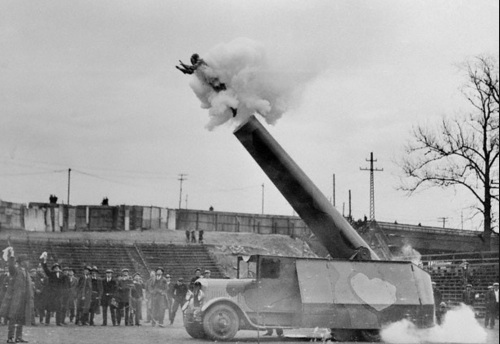
I Finally Found Something To Move Me
Overcoming inertia, correctly applied with the S.A.I.D. principle (see What Nature S.A.I.D part 2) explain almost all the techniques behind strength training. When your body runs up against a weight it can’t move either at all or for enough repetitions, it responds by adding muscular mass in order to generate more force, to overcome the added inertia of the heavier weight.
You wouldn’t question that, right? It’s an obvious enough wisdom for us to accept its application to these ‘dead’ things, objects made of paper, leather, or iron.
Physically we are made from similar stuff, exist in the same environment, and live under the same laws of Nature. Breeze, bat, or dynamite-charged cannon will move you from here to there, and how far that is will be depending on your physical mass and how much external force is applied. You’ll move whether you want to or not.
But what about psychological mass?
 stormcrossing
Leave a comment
Comments feed for this article