
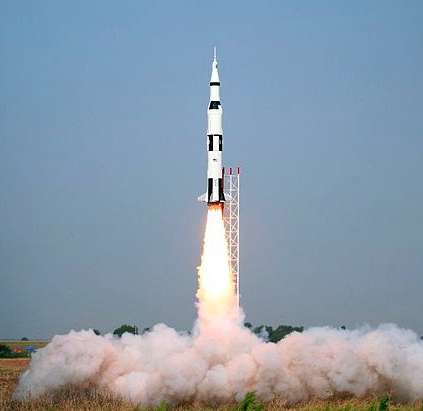
Machine Overcoming Inertia
The first law of motion states that the heavier something is (more mass), the force required to change its direction, or get it to move if it is not moving, increases in proportion to its increase in mass.
In ‘dead things’ like automobiles, planes, trains, and boats, engines that contain chemical reactions produce force to overcome the inertia contained in their static forms. The larger the object, the more powerful the engine, until even giant objects the size of the space shuttle can be motivated to actually leave the earth itself.

Animal Overcoming Inertia
In ‘living things’ the stimulating force required to overcome inertia is often self-generated, arising from somewhere inside, and can be powerful enough to move a huge amount of physical mass. In this way a massive but hungry tiger may be enticed by food across a stream, while a lightweight and satiated housecat wouldn’t move a whisker. The ‘decision’ itself is catalytic, causing the increase in energy needed to overcome the animal’s tendency to stay put.

What Psychological Inertia Feels Like
In most of the animal kingdom it appears decisions are based on instinct and reflex. They are either moving their physical mass, or not. But in humans there is a further, critical process. It involves the addition of psychological mass, an increase in spiritual (non-physical) inertia that accompanies repeated feelings of guilt, embarrassment, shame, disgust, sadness, anxiety, and other heavy feelings that add ‘weight’ to the psyche.
 stormcrossing
Leave a comment
Comments feed for this article